
A Morning on Mars: Curiosity Reveals a Landscape Full of Mysteries
Soft morning light, an extraordinary landscape and a robot that has been exploring another planet for more than 14 years. NASA’s Curiosity rover has sent home a remarkable image — one that is beautiful in its own right and raises new questions about the history of Mars.
Morning light, millions of kilometres from Earth
Imagine standing on a ridge in the morning. The Sun climbs higher, the first light reaches the distant rocks, and an apparently endless landscape stretches away in front of you.
It sounds like an ordinary scene on Earth. Except this photograph was taken somewhere else entirely.
It was taken on Mars.
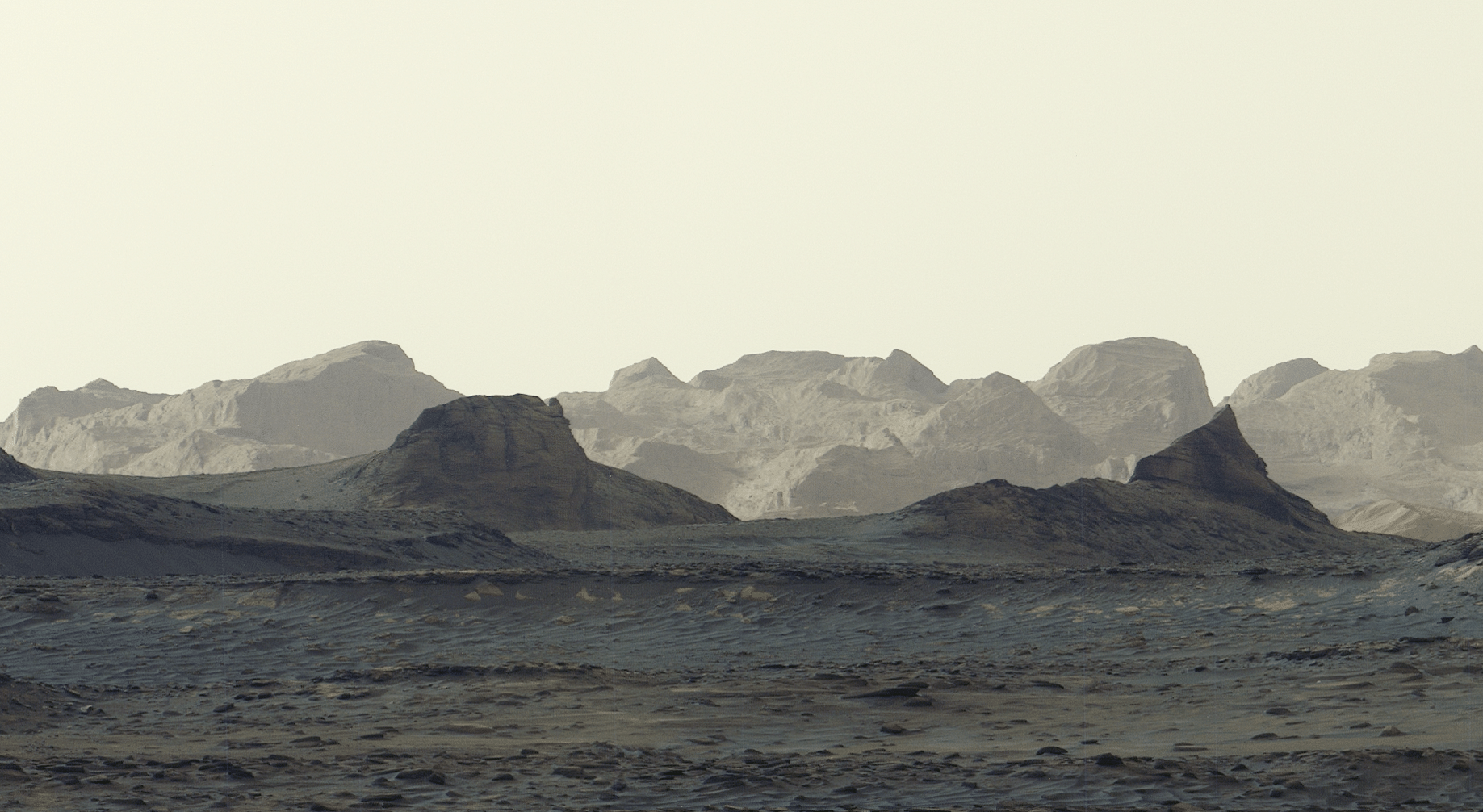
On 11 August 2026, at around 8:30 a.m. local Mars time, Curiosity turned its camera towards an unusual rock formation on Mount Sharp. NASA released the panorama on 6 October.
The foreground has cool, sometimes bluish tones, while the far-off cliffs catch the warmer morning sunlight. For a moment, it is almost possible to forget just how far away this place is.
And that, to me, is exactly what makes photographs like this so captivating.

Six photographs, one remarkable view of Mars
Curiosity captured the scene with its Mastcam, a camera system mounted high on the rover’s mast. Rather than taking one photograph, it recorded six separate frames. The images were transmitted back to Earth and stitched together into a panorama.
What makes the final image especially interesting is how the mission team processed it. Many Mastcam pictures normally undergo white balancing so that scientists can compare colours and geological features more consistently.
For this panorama, the team deliberately skipped that step. The distinctive character of the early morning light was allowed to remain.
That does not necessarily mean the picture reproduces exactly what human eyes would see on the Martian surface. The sensor, image processing and local lighting all influence the result. But it certainly gives us a striking impression of this distant world.
Anyone who enjoys photography will recognise the dilemma: a technically neutral white balance and a faithful sense of atmosphere are not always quite the same thing.
Mysterious cliffs sculpted by the wind
As impressive as the panorama is, the formations on the horizon are what really interest the scientists. They are called yardangs.
Yardangs are elongated ridges and rock formations created by wind erosion. Over immense stretches of time, wind removes softer material, while more resistant rock remains as ridges, sharp edges and cliffs.
You can find similar landforms on Earth, particularly in dry desert regions. On Mars, though, they may preserve clues to a geological story that researchers are still piecing together.
This yardang layer extends for approximately 16 kilometres (10 miles) across the northwestern part of Mount Sharp. Its different colour and the unusual angle of its layers make it stand out from the surrounding geology.
One possibility is that some of this material began as volcanic ash deposited in the distant past. At present, however, that remains a hypothesis rather than an established conclusion.
Which is precisely why the scientists are eager to examine the rocks up close.
Mount Sharp: a history book written in stone
To understand the appeal of these cliffs, it helps to look at where they are. Mount Sharp rises roughly five kilometres (three miles) above its surroundings inside Gale Crater. Curiosity has been slowly climbing its slopes since 2014.
In a sense, the rover is driving through an enormous geological history book. Each layer of rock records a different chapter in the story of Mars.
Today, Mars is cold and dry, with a very thin atmosphere. Yet Curiosity has found evidence that rivers and lakes once existed in this region billions of years ago. Water transported and deposited sediment; as conditions became drier, minerals including salts were left behind.
These clues help scientists address a fundamental question: How did a world that once held considerably more liquid water become the dry Mars we see today?
And there is another question behind it. Could the planet once have had conditions suitable for simple microbial life? Such environments may have existed, but that is not proof that life ever developed there.
Curiosity still has a long road ahead
Curiosity landed in Gale Crater on 6 August 2012. Its original prime mission was planned to last around one Martian year. More than 14 Earth years later, the rover is still exploring — a remarkable achievement for a machine operating in such a harsh and remote environment.
In 2026 it passed another milestone, having climbed around one kilometre in elevation since it began ascending Mount Sharp.
The most intriguing yardangs are still farther ahead. NASA hopes Curiosity can reach the base of the layer during 2027. There, the rover could use its robotic arm and scientific instruments to examine the material directly.
Perhaps those investigations will reveal whether ancient volcanic ash really did play a part in forming these unusual rocks. Until then, the formation remains one of Mars’s geological puzzles.
Why images like this still amaze me
Astronomy so often deals in enormous distances: galaxies whose light has travelled for millions of years, nebulae where stars are forming, or planets that appear as tiny discs through our telescopes.
And then a rover sends us a picture of another planet’s landscape, almost as though we were standing there ourselves.
Of course, Curiosity is first and foremost a scientific mission. It studies rocks, climate history, minerals and the possibility that environments suitable for life existed long ago.
But sometimes one photograph is all it takes to remind us why we explore space in the first place: curiosity, the desire to understand, and the irresistible urge to look beyond our own horizon.
An ordinary morning on Mars — and an extraordinary sight for those of us here on Earth.
What fascinates you more: the landscapes of other worlds, or the scientific mysteries they still hold?
Sources and further reading
NASA/JPL: Curiosity Rover Catches Stunning Martian Dawn (6 October 2026)
NASA/JPL: Original panorama PIA25629 and image credit
Image credit: NASA/JPL-Caltech/MSSS. This article is independent and is not produced or endorsed by NASA or JPL.