
When the sky gets in touch – Foto-Gorilla’s new personal push notifications
Some website features are added because they are useful. And then there are features where, at some point, you realise: this has become much more than a small extra.
The new Foto-Gorilla push notifications definitely belong to the second category for me.
The original idea was surprisingly simple: why should I keep checking weather apps, astronomy software and observing plans myself when Foto-Gorilla could simply tell me when looking up is genuinely worth it?
Not sometime. Not somewhere. At my own observing location – and with the information I actually need outside.
That simple thought gradually turned into a system that can do quite a bit more than I initially planned.
Foto-Gorilla can now do more than notify you about new articles. It can take your observing location into account, check weather conditions, consider astronomical darkness, evaluate moonlight and calculate how favourable deep-sky objects and planets are at a given time.
The goal is not to produce another complicated table. Ideally, it should result in a message such as:
M57 – 63° high – southwest.
Or:
Jupiter – 38° – southeast – best time 23:00.
In other words: exactly the kind of information that saves you from opening three more apps first.
The idea: less searching, more observing
If you spend a little more time with astronomy or astrophotography, you probably know the routine.
First you check the weather forecast. Then perhaps a second one, because it says something completely different. Next comes cloud cover, then humidity, then the time astronomical darkness begins. After that the Moon enters the equation.
Eventually you open Stellarium or another astronomy app and discover that the object you wanted to photograph is only just above the horizon at the interesting time.
Or, even worse, you find out the following morning that the previous night had actually been surprisingly clear and excellent.
I wanted Foto-Gorilla to solve that in a different way.
The site should not simply become another collection of astronomy information. It should start connecting information in a useful way.
The key question eventually became:
Can Foto-Gorilla recognise by itself when an observing night at a specific location is genuinely worthwhile?
By now, the answer is yes. And that is where a small idea turned into a rather exciting project.
Five topics – and you decide for yourself
One thing mattered to me from the very beginning: push notifications must not become annoying.
There are few quicker ways to make people turn notifications off than sending a message about every little thing.
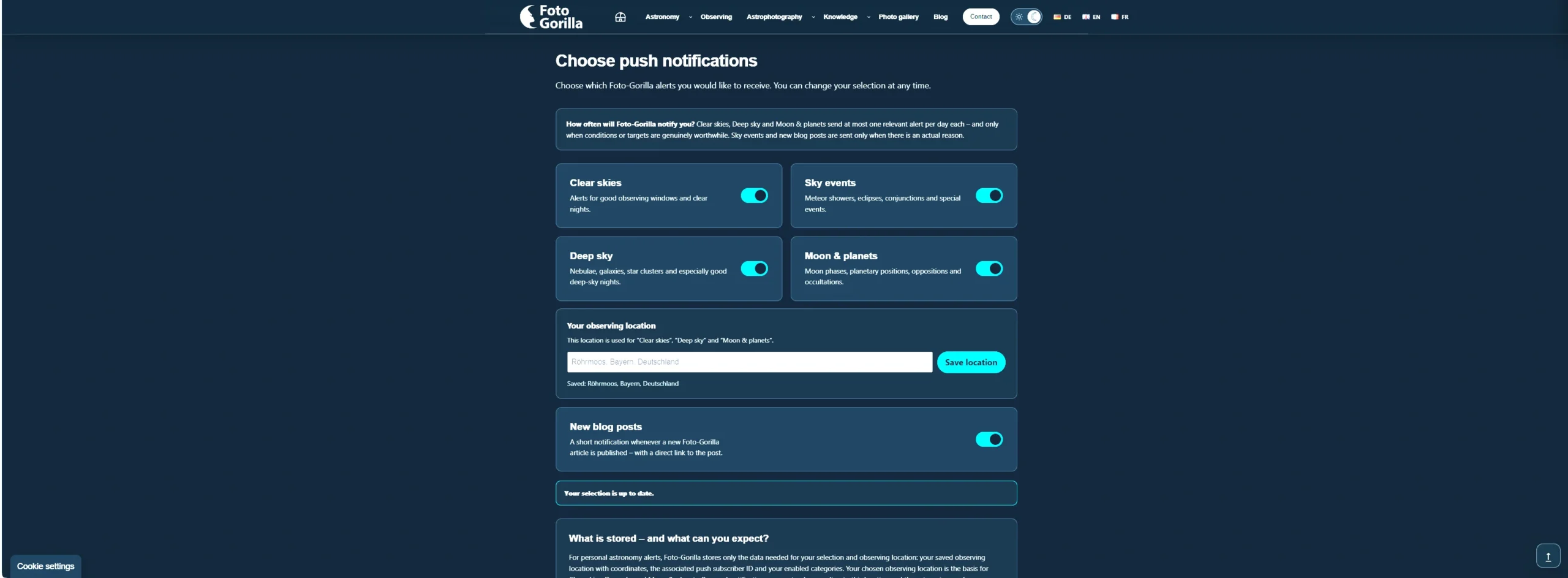
So Foto-Gorilla does not use one general stream of alerts. Everyone can choose which information is relevant.
- Clear skies
- Sky events
- Deep sky
- Moon & planets
- New blog posts
Each category can be enabled or disabled independently. If you only want to know when a particularly good deep-sky night is coming up, you can select Deep sky only. If meteor showers, eclipses and other special events are your thing, choose Sky events. And if you simply do not want to miss a new Foto-Gorilla article, activate New blog posts.
You can of course enable everything, and your choices can be changed at any time.
You can manage everything directly on My Notifications.
One observing location for personal alerts
It quickly became obvious that personalised astronomy notifications are only half as useful without an observing location.
A clear night in Hamburg is not much help to an observer south of Munich. Even within the same region, cloud and local weather can vary considerably.
That is why Foto-Gorilla lets you save your own observing location.
This location is used for three personal features: Clear skies, Deep sky and Moon & planets.
From the place you enter, the system determines the geographic coordinates and the appropriate time zone. That allows it to calculate when astronomical darkness begins there, how high a deep-sky object will be, in which direction it is located, where the Moon is, how much moonlight may affect a faint target and when a planet reaches a useful altitude.
And of course it also checks the weather for that exact location.
This is what turns general astronomy information into personal observing guidance.
Clear skies means more than “no rain”
The first version could have been very simple: “It will be clear tonight.”
But for astronomy, that does not tell you very much. A dry night is not automatically a good observing night.
So Foto-Gorilla evaluates several factors together, including:
- cloud cover
- probability of precipitation
- actual precipitation
- visibility
- humidity
- temperature
- dew point
- fog risk
- astronomical darkness
A single short gap in the clouds is not enough either. A notification would be rather pointless if the sky opened between 23:00 and midnight and closed again immediately afterwards.
The system therefore looks for a continuous, genuinely useful observing window. Only if the conditions make sense does it send an alert.
A message might look something like this:
Clear skies near Röhrmoos
Good conditions roughly 22:00–02:00: little cloud, dry and low fog risk.
That is the philosophy behind the whole system: not as many messages as possible, but only the ones that are genuinely useful.
Deep sky – where things became really interesting
The Deep sky feature is probably the part of the system I enjoyed building most.
At this point, a weather forecast alone is nowhere near enough.
A deep-sky object may technically be visible and still be a poor target that night. Perhaps it is too low. Perhaps the Moon is almost full. Perhaps the Moon sits close to a faint galaxy. Or perhaps another object is simply much better placed at the same time.
Foto-Gorilla therefore evaluates a curated selection of interesting deep-sky targets, including galaxies, emission nebulae, planetary nebulae, open clusters and globular clusters.
The important question is not simply whether an object is above the horizon. It is how worthwhile it is that night.
Altitude above the horizon
One important factor is altitude. The higher an object stands in the sky, the less atmosphere its light has to pass through. That usually means less haze, fewer atmospheric disturbances and often better conditions for both observing and astrophotography.
So higher objects receive a better rating. A target at 60 or 70 degrees is usually much more attractive than the same target close to the horizon.
The altitude is shown directly in the notification, for example: M27 – 62°.
The Moon – our natural floodlight
For faint nebulae and galaxies, the Moon can make a big difference. Bright moonlight raises the sky background and can hide delicate detail.
But looking at the lunar phase alone would still be too simplistic. Where the Moon is matters too.
A bright Moon on the opposite side of the sky may be much less troublesome than the same Moon only a few degrees from a faint galaxy.
Foto-Gorilla therefore takes into account factors such as lunar brightness, the Moon’s position and its separation from the deep-sky target.
Different object types are treated differently as well. Faint galaxies and nebulae are more sensitive to moonlight than compact star clusters or some planetary nebulae.
It also has to be properly dark
Another detail was important to me: just because an object is high in the sky does not mean it is already worth observing.
The Deep sky selection therefore also considers the Sun’s position. The useful evaluation window is based on astronomical darkness.
Only once the Sun is far enough below the horizon do faint deep-sky objects become truly interesting.
And then came the direction
During development, another very obvious question appeared.
What good is a message saying M57 – 63° if I still need to open another app to find out where to look?
So the system grew again.
Foto-Gorilla now calculates the direction as well. In the background, the observing location, time and object position are used to determine the azimuth.
You do not have to deal with a technical angle. 225 degrees simply becomes SW – southwest.
A Deep sky notification can therefore look like this:
Deep sky tonight near Röhrmoos
Especially good: M27 62° SW, M57 63° SW, NGC6543 61° NW.
And a message exactly like that arrived during the first real test – on my phone and on my computer at the same time.
I admit that was one of those moments when you look at the screen and grin for a second. A few ideas had suddenly turned into a small, working sky assistant.
Moon & planets – when and where should you look?
The Moon & planets section follows a similar idea. It focuses on interesting lunar phases and favourable planetary positions.
For planets, Foto-Gorilla can determine which object is currently interesting, how high it stands, when it is best placed and in which direction you can find it.
That turns a vague statement such as “Jupiter is visible tonight” into something much more useful:
Jupiter – 38° – SE – 23:00
That is the information you really need outside: what, where, how high and when.
Sky events – things you do not want to miss
Some nights are not about the weather or a particular deep-sky object. Sometimes something special simply happens in the sky.
That is what the Sky events category is for.
It can cover meteor showers, solar and lunar eclipses, oppositions, conjunctions and other unusual astronomical events.
Major events can be announced several days in advance, with another reminder closer to the event when appropriate.
The direction is included here too. A meteor shower might show Look: NE; a planet at opposition might read Look: E → S → W.
For eclipses or other events where the exact direction depends strongly on time and location, Foto-Gorilla deliberately remains more general. I prefer an honest, slightly broader instruction to a precise-looking statement that may be wrong.
And of course: new blog posts
Not every push notification needs astronomical calculations.
If you want, Foto-Gorilla can simply tell you whenever a new article is published. One short notification, one direct link, done.
No daily reminders and no unnecessary noise.
How often will Foto-Gorilla notify you?
This was an important point from the start. Push notifications can be extremely useful, but they can become tiring just as quickly.
For the personal categories Clear skies, Deep sky and Moon & planets, Foto-Gorilla sends at most one relevant alert per category per day – and only when there is a good reason.
Bad conditions? Foto-Gorilla stays quiet.
No worthwhile target? No notification.
Sky events only appear when an actual event is approaching, and blog alerts only appear when there is a new article.
The principle is simple: not as often as possible – only when it is worth it.
Transparency and privacy are part of the feature
As soon as a personal observing location is used, it should also be clear what happens to that information.
The notification page therefore explains what is required for the personal functions. This includes the observing location you enter, the coordinates derived from it, the time zone, the technical push subscriber ID and the notification categories you selected.
Those details are used to calculate and deliver the location-based alerts you have chosen. The Foto-Gorilla privacy information has been updated accordingly in German, English and French.
From a blog to a small personal sky assistant
When I started Foto-Gorilla, the main goal was to explain astronomy and astrophotography in an understandable way. That is still at the heart of the site.
But the new push notifications show rather nicely where Foto-Gorilla can go next.
Not simply displaying information, but connecting it.
Location. Weather. Darkness. Moonlight. Object position. Direction. Time.
And ideally all those individual pieces do not end in a complicated table, but in one small message:
Tonight is worth it.
Look southwest at around 23:00.
Simple at the end – even if the route to that simple message is a little more involved behind the scenes.
What comes next?
Is the feature finished? At its core, yes.
But Foto-Gorilla is not meant to be a site where one day someone says, “Right, finished. Nothing changes from now on.”
There are always more ideas. Perhaps one day the system will distinguish more clearly between visual observing and astrophotography. Perhaps filter recommendations will be added. Maybe transparency or seeing will play a role. Perhaps several observing locations will be possible.
That does not all have to happen tomorrow.
But this is exactly what I enjoy about building Foto-Gorilla. Many features begin with one very simple question:
“Why do I have to look all of this up manually every single time?”
Sometimes that question becomes something that makes observing a little easier for everyone.
Try the new notifications
You can set up your personal preferences directly on Foto-Gorilla.
Choose whether you want alerts for clear skies, sky events, deep sky, the Moon & planets or new blog posts. For Clear skies, Deep sky and Moon & planets you can also save your own observing location.
All settings can be changed again at any time.
Choose your push notifications now
And after that, there is really only one thing left to do: